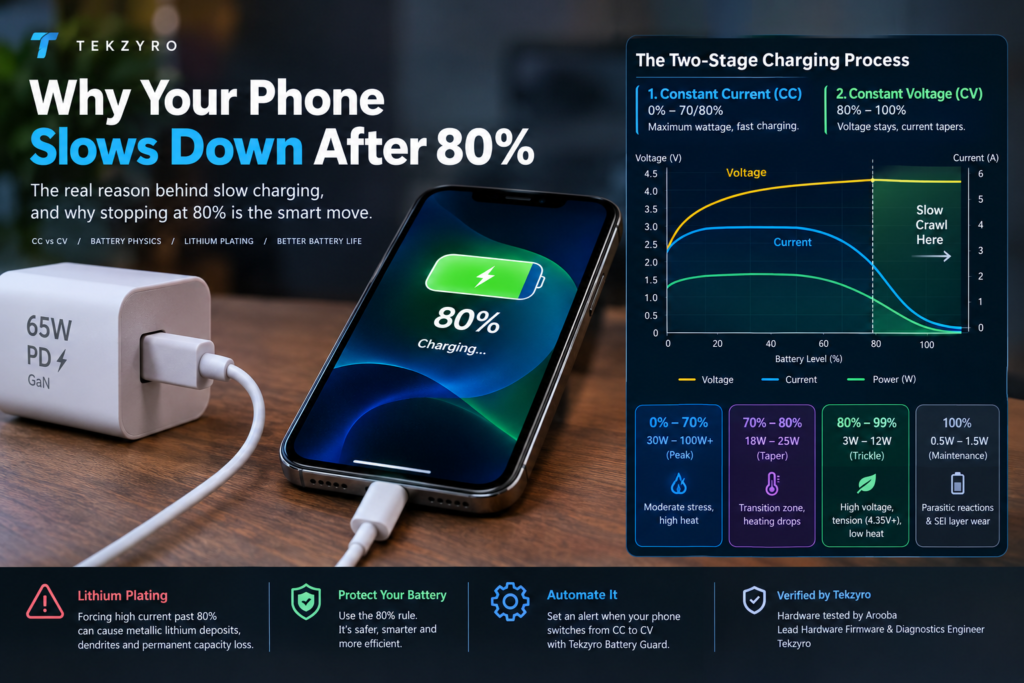
You plug your smartphone into a 65W, 80W, or even 120W ultra-fast charger with a depleted 5% battery. In twenty minutes, the phone surges up to 60%. Ten minutes later, it crosses 75%. But then, an abrupt and baffling slowdown occurs: crawling from 80% to 100% takes almost as long as the entire initial charge cycle combined.
Many smartphone owners assume their wall adapter is defective, their braided cable is degrading, or their battery management IC has suffered a fault. In reality, this sudden wattage plummet is an intentional, hard-coded safety mechanism governed by fundamental electrochemical laws. As we uncovered in our deep dive into the 80% battery rule and lithium degradation, pushing maximum wattage into a high-saturation battery is hazardous to cell integrity.
This technical analysis explains the precise physics behind Constant Current (CC) versus Constant Voltage (CV) charging, why modern Power Delivery (PD) protocols force your phone to throttle, and why pulling the plug at 80% is the ultimate power-user efficiency move.
The Two-Stage Charging Architecture: CC vs. CV
Modern lithium-ion and lithium-polymer cells cannot accept a flat, constant stream of high electricity from empty to full. Doing so would cause catastrophic cell overheating, electrolyte oxidation, and catastrophic thermal runaway. Instead, smartphone Power Management Integrated Circuits (PMICs) divide the charging sequence into two distinct phases:
Phase 1: Constant Current (CC) / The Bulk Fast-Charge Stage (0% to ~70-80%)
During the early phase, the lithium intercalation spaces inside the graphite anode are completely empty and ready to accept lithium ions rapidly. The charger supplies maximum allowable amperage while the battery’s terminal voltage climbs steadily from around 3.2V up toward its design ceiling (typically 4.2V to 4.45V). This is where proprietary charge protocols (Qualcomm Quick Charge, USB-PD Programmable Power Supply / PPS, Oppo SuperVOOC) deliver headline speeds.
Phase 2: Constant Voltage (CV) / The Saturation Absorption Stage (80% to 100%)
Once cell potential reaches its electrochemical limit (approximately 4.20V to 4.35V), the PMIC clamps the voltage permanently at that peak threshold. Because the voltage can no longer rise without causing irreversible chemical breakdown, the incoming electric current (amperage) must taper down in a steep downward decay curve. Power (Watts = Volts × Amps) drops dramatically from 65W down to 15W, then 5W, and finally under 1W as the cell nears full saturation.
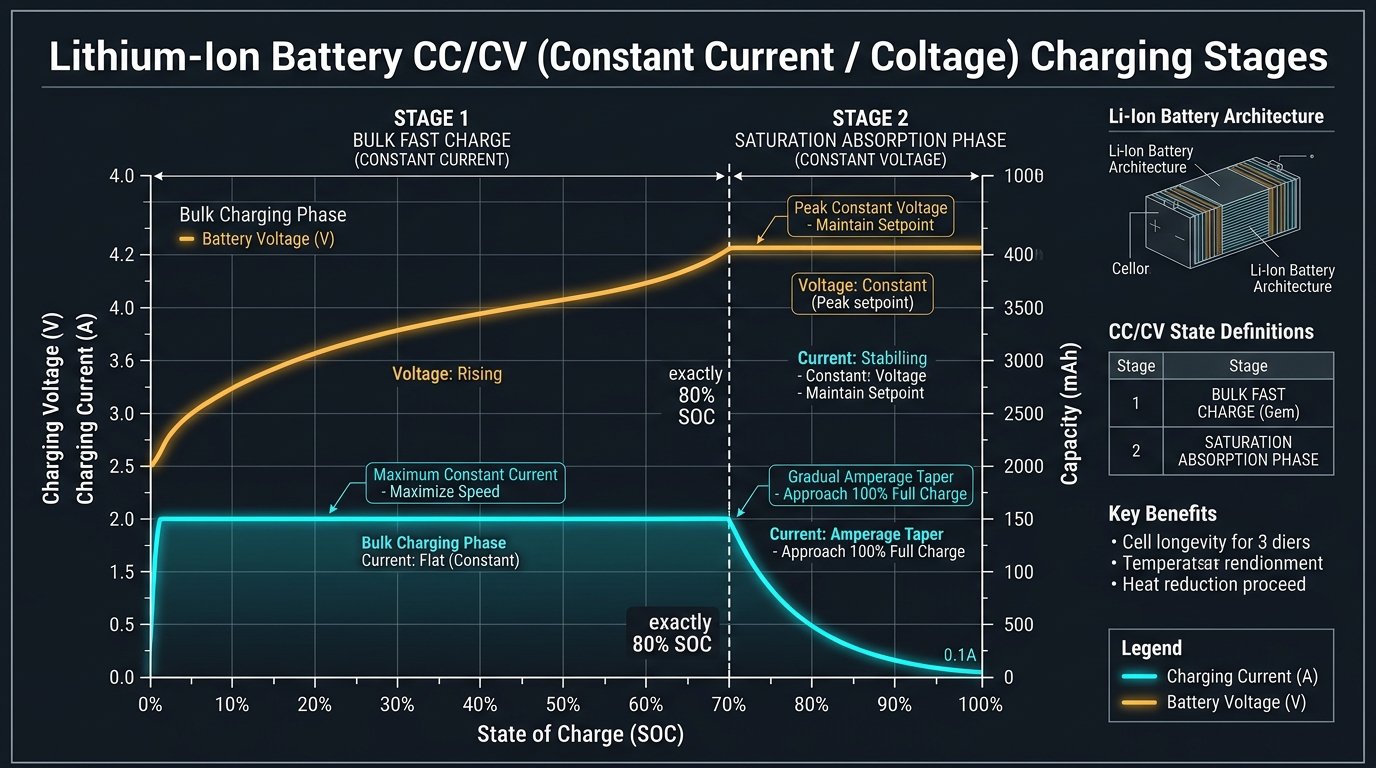
Lithium-Ion Charging Phase Breakdown
Why Forcing Full Speed Past 80% Destroys Batteries: Lithium Plating
What would happen if your phone manufacturer bypassed the CC/CV taper and shoved 65W into the cell all the way to 100%? The primary danger is a microscopic chemical disaster known as Lithium Plating.
When a battery is near capacity, the interstitial spaces between graphite layers in the negative electrode are largely occupied. If lithium ions are forced toward the anode faster than they can physically diffuse into the crystal structure (intercalate), they begin depositing on the surface of the anode as metallic lithium.
- Permanent Capacity Loss: Metallic lithium cannot cycle back into energy storage, permanently reducing your device’s maximum milliampere-hour rating.
- Internal Dendrite Growth: Metallic deposits form needle-like microstructures called dendrites. Over dozens of high-voltage cycles, these dendrites can pierce the porous polymer separator membrane, causing catastrophic internal micro-shorts.
- Thermal Overheating: Combined with external ambient heat—such as using your phone for navigation during a road trip—excessive saturation turns high-performance silicon into a thermal hazard. If you regularly charge while driving, review our guide on preventing smartphone overheating inside vehicles.
The Practical Fix: Stop Waiting on the 80% to 100% Crawl
Once you understand the physics of the CC/CV curve, the solution becomes obvious: waiting for that final 20% is mathematically inefficient and chemically damaging. Spending 40 minutes connected to a wall socket just to accumulate the final 20% of your charge yields diminishing returns.
Instead of monitoring your lock screen every five minutes, you can automate this threshold using our step-by-step Tekzyro Battery Guard setup guide. By configuring an automated acoustic alert the exact millisecond your phone crosses from high-speed Constant Current into slow Constant Voltage saturation, you eliminate cell stress and free up your device for daily use.
Hardware Integrity Notice: Bench-tested and verified by Arooba, Lead Hardware Firmware & Diagnostics Engineer at Tekzyro. Oscilloscope and USB-C inline power analyzer benchmarks recorded across GaN 65W/100W PD 3.0 PPS test benches. For technical consultations or laboratory testing methodology questions, contact support@tekzyro.com.