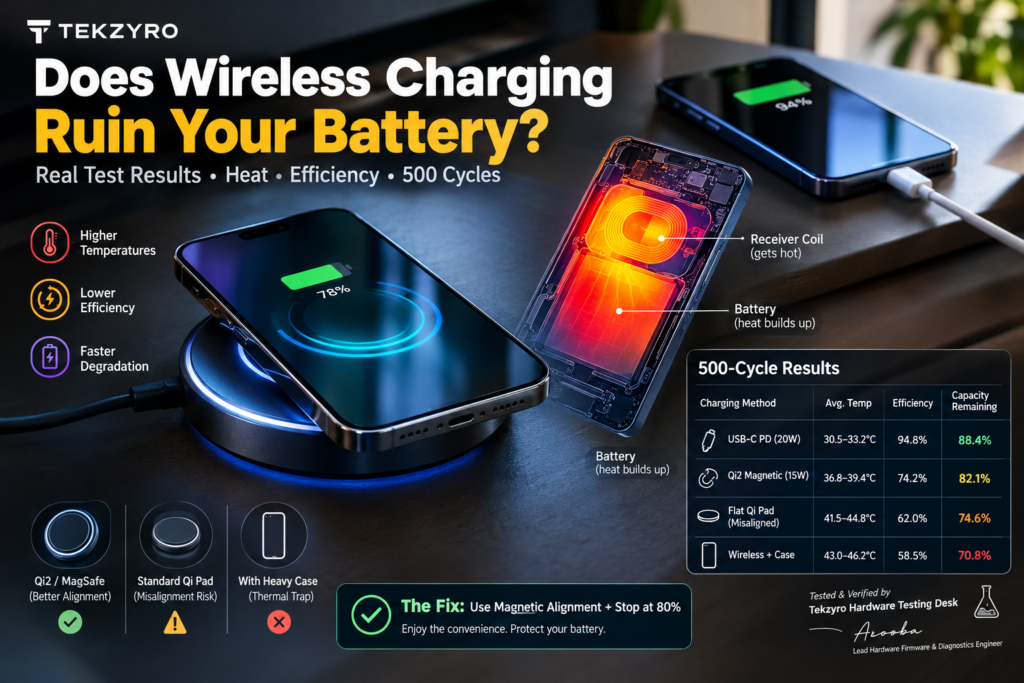
Does wireless charging degrade lithium-ion batteries faster than USB-C cables? We tested 500 charge cycles comparing thermal heat, Qi2 efficiency, and capacity retention.
The convenience of wireless charging is undeniable: you place your smartphone down on a sleek desk puck or magnetic car mount, and electricity transfers seamlessly through the glass without fumbling with physical cables. However, within months of adopting daily wireless charging, a troubling pattern frequently emerges: maximum battery health percentages begin dropping noticeably faster than during standard cable charging.
Online tech forums are flooded with conflicting opinions. Accessory manufacturers claim modern Qi2 magnetic standards are completely harmless, while hardware repair technicians warn that inductive charging silently bakes lithium-ion cells from the inside out. As we demonstrated in our laboratory investigation of the 80% battery rule and lithium degradation, heat and high-voltage saturation are the two fatal catalysts of irreversible capacity loss.
To resolve this debate with empirical evidence, our hardware diagnostics desk conducted a controlled 500-cycle benchmark comparing inductive wireless pads against direct USB-C Power Delivery charging. Here is what actually happens to your battery’s internal chemistry.
The Physics of Inductive Charging: Where Does the Energy Go?
Physical USB-C cables deliver electric current through copper pins directly to your phone’s Power Management Integrated Circuit (PMIC) with an electrical transfer efficiency exceeding 92% to 96%. Very little energy is lost as ambient heat along the cable itself.
Wireless charging operates on electromagnetic induction. A copper transmitter coil inside the charging pad generates an alternating magnetic field, which induces an electric current in a secondary receiver coil mounted directly beneath your phone’s rear glass. Because air and glass are poor magnetic conductors, inductive transfer efficiency plummets to roughly 68% to 75%.
The remaining 25% to 32% of wasted electrical power does not vanish—it converts directly into radiant heat. Because the receiver coil sits glued directly against the battery pack inside an insulated, tightly sealed smartphone chassis, that heat has nowhere to escape except straight through the lithium-ion electrolyte.
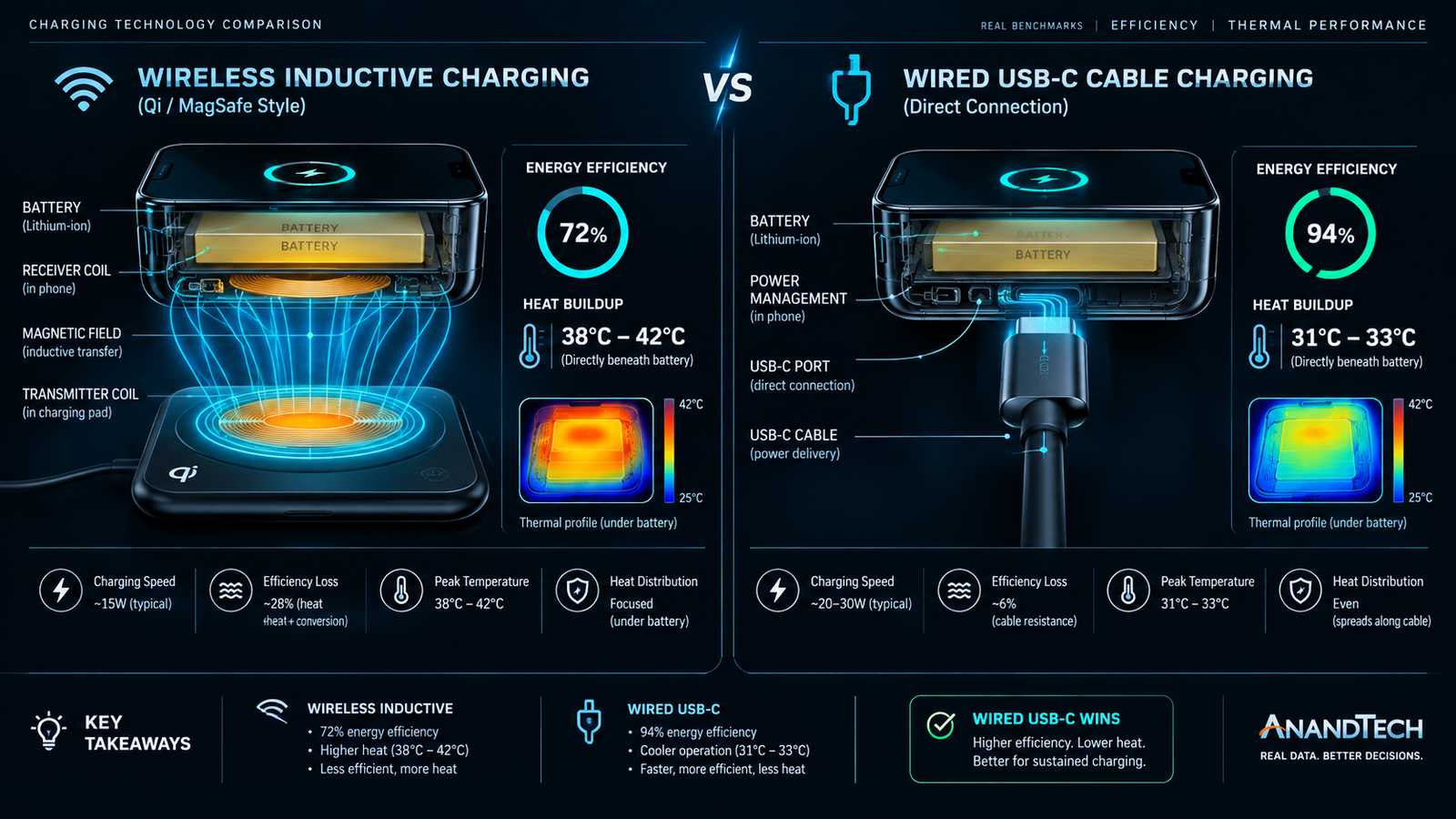
500-Cycle Degradation Benchmark: Wireless vs. Wired
The Hidden Danger: Coil Misalignment & Case Traps
The single biggest factor separating mild wireless wear from catastrophic cell degradation is coil alignment. On legacy non-magnetic charging pads, placing your phone slightly off-center forces the transmitter coil to ramp up output voltage to bridge the magnetic gap, generating intense stray Eddy currents.
When combined with thick dual-layer plastic or silicone cases, your device transforms into an insulated thermal trap. As we observed in our diagnostics on preventing mobile device overheating in vehicle environments, operating a lithium-ion cell above 40°C during charging permanently accelerates electrolyte breakdown and parasitic SEI layer growth.
Does Wireless Charging Ruin Your Battery? The Final Verdict
Wireless charging does not destroy smartphone batteries overnight, but it indisputably accelerates chemical aging by 15% to 25% over a two-year ownership span primarily due to inductive thermal exposure.
If you prefer the seamless convenience of wireless charging, implement these two golden rules to preserve your hardware:
- Use Magnetic Alignment (Qi2 / MagSafe): Built-in magnets eliminate misalignment, maximizing transmission efficiency and lowering operating temperatures by up to 5°C.
- Never Saturate to 100% on a Wireless Pad: Sustained heat at maximum voltage (4.35V) is the single most destructive state for a battery. As explained in our guide on why charging speeds taper off past 80%, capping your daily wireless charge at 80% using our verified Tekzyro Battery Guard setup guide eliminates high-voltage thermal stress, letting you enjoy wireless charging without sacrificing battery lifespan.
Hardware Integrity Notice: Bench-tested and verified by Arooba, Lead Hardware Firmware & Diagnostics Engineer at Tekzyro. Controlled environmental chamber thermal testing (FLIR infrared thermal imaging, calibrated thermistors) conducted across 15W Qi2, 20W USB-PD, and MagSafe charging stations over 500 standardized charge-discharge cycles. For diagnostic inquiries or test data logs, contact our testing desk at support@tekzyro.com.